Table of Contents
Executive Summary: Fixing Rogue Listing Data
- Google Business Profile data is not permanently locked by the business owner. Google continuously alters listing information based on user edit suggestions, AI web-scraping, and third-party directory aggregators.
- When Google accepts an external edit suggestion, it appears in your dashboard in orange text labeled 'Google updates'. If you ignore these alerts, Google will publish the changes publicly.
- Incorrect information—such as a misplaced map pin, wrong phone number, or false 'Permanently closed' status—causes massive customer loss and damages local search rankings.
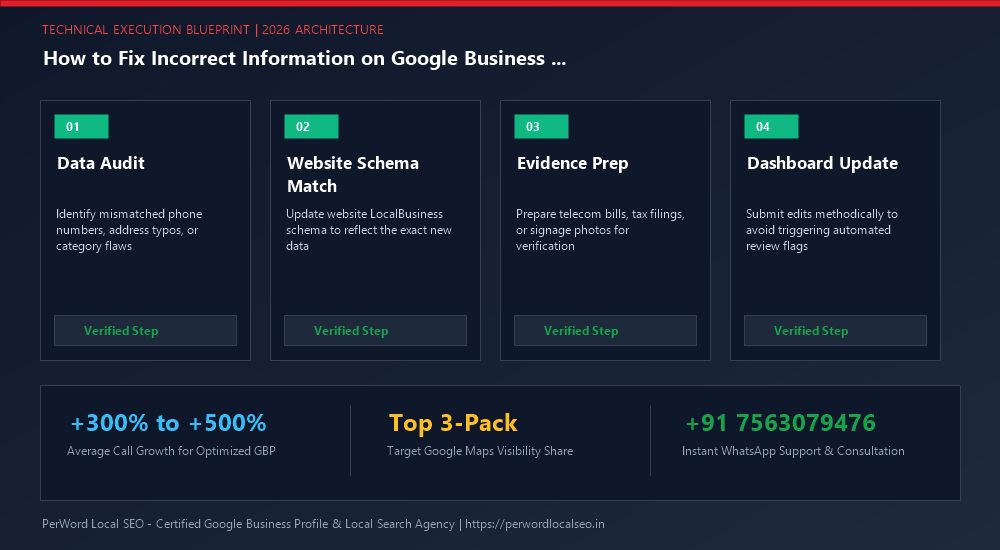
- To permanently fix incorrect data, you must harmonize your Ground Truth across your official website schema, authoritative citations, and Google Maps pin calibration.
1. Why Incorrect Information Infiltrates Listings
Many business owners assume that once their profile is verified, their data remains immutable. In reality, Google treats local listings as open, crowdsourced collaborative knowledge graphs. Google believes that collective user data and autonomous web scraping often produce fresher information than business owners who fail to update their profiles.
Google ingests data from four distinct external channels:
User Suggestions
Local Guides and random consumers tapping 'Suggest an edit' on Google Maps.
AI Web Crawlers
Googlebot scraping outdated third-party directories or competitor mentions.
Data Aggregators
Bulk syndication feeds from municipal business registries and telecom databases.
Competitor Sabotage
Malicious competitor campaigns falsely reporting your business as closed or moved.
3. Identifying & Rejecting Unwanted Google Updates
When Google changes information on your listing, it displays orange text in your Search NMX console. Follow this protocol to reject bad edits:
How to Handle 'Google Updates' Alerts
- Access the Affected Field: Click the section containing orange text (e.g., Business Hours or Phone).
- Inspect the Suggested Change: Note the difference between your entered data and Google's suggested data.
- Discard or Accept: Click 'Discard' or click your original text to reject Google's edit and lock your authentic information.
- Lock External Sources: If Google repeatedly attempts to change the same field, inspect your linked website and major citations (Justdial, Yelp) for conflicting data.
6. The Crowdsourced Edit Defense Architecture
Google’s algorithms rely heavily on consensus. If multiple Local Guides or competitors suggest the same edit, Google’s automated system assumes the edit is accurate unless you actively contradict it:
The 3-Tier Entity Defense Wall
- Tier 1: Website Knowledge Graph Synchronization: Ensure your website’s JSON-LD schema explicitly declares your business hours, phone number, and physical coordinates. Googlebot cross-checks suggested edits against your schema.
- Tier 2: Instant Dashboard Triage: Log in every Monday morning to review pending edits. Discarding an edit immediately signals to Google’s AI that the suggestion is invalid.
- Tier 3: Google Product Expert Escalation: If a persistent competitor is launching automated bot scripts to suggest edits, file an official Redressal Complaint to place a temporary edit lock on your listing.
How to Submit an Anti-Spam Redressal Complaint
If a competitor is repeatedly sabotaging your listing with automated bots or false closure reports, self-service dashboard edits are not enough. You must file an official Google Business Profile Redressal Complaint Form. Attach evidence screenshots of your active storefront, utility bills, and proof of competitor malicious behavior. Google Trust & Safety will place a manual freeze preventing crowdsourced edits on your entity.