Table of Contents
Executive Summary: Climbing the Google Maps Ladder
- Capturing positions 1, 2, or 3 on Google Maps is the single most profitable digital marketing achievement for a local enterprise, generating over 70% of inbound commercial call volume.
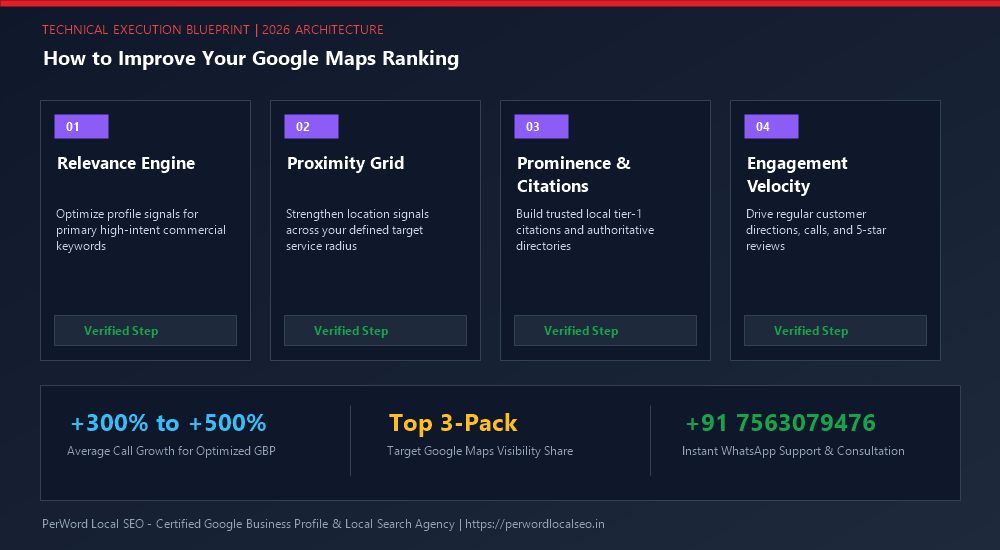
- Climbing Google Maps rankings requires mastering the three core algorithmic pillars: Relevance (accurate categories, products, and services), Distance (proximity calibration and service radius), and Prominence (review velocity, backlink authority, and citation consistency).
- Never rely on static profile configuration. Google rewards active businesses that consistently upload authentic photography, respond to reviews within 24 hours, publish weekly updates, and maintain 100% accurate operational hours.
- Your linked website is an indispensable ranking driver. Ensuring fast mobile page speed, local schema markup, and geo-targeted service headers directly elevates your Google Maps placement.
1. The Google Maps Ranking Imperative: Clicks vs. Obscurity
In local search, there is a brutal digital divide between the top three listings and everyone else. Eye-tracking heatmaps and consumer click-behavior studies reveal that the top 3 positions in the Google Maps 3-Pack capture over 85% of all phone calls, direction requests, and website visits.
If your business ranks at position #7 or #12, you are essentially invisible to mobile consumers who need immediate solutions. To move up the rankings, you must execute a systematic, multi-faceted optimization campaign that signals undeniable commercial authority to Google's ranking algorithms.
2. Step 1: Algorithmic Primary & Secondary Category Calibration
Your Google Business Profile category structure carries the single heaviest algorithmic weight for query matching. If this foundation is flawed, no amount of reviews or citations will push you to #1.
Primary Category Precision
Perform competitive espionage using tools like PlePer or GMB Everywhere to identify the exact primary category used by the top 3 ranking listings in your city. Align your primary category with the highest-margin commercial intent.
Secondary Category Stacking
Add between 3 and 6 carefully chosen secondary categories that represent legitimate secondary services. Avoid stuffing irrelevant categories, which dilutes topical focus and confuses Google's semantic index.
3. Step 2: High-Resolution Visual Asset Pipeline
Google Maps is an intensely visual platform. Profiles that regularly upload high-resolution, geotagged, real-world imagery achieve significantly higher engagement metrics, which directly boosts local rankings.
- Storefront & Signage: Clear photos of your exterior building, parking lot, and front entrance from multiple angles during daytime and evening.
- Interior Commercial Ambience: Clean, well-lit photos showing your reception desk, customer waiting area, consultation rooms, or dining floor.
- Team & Operations: Real photographs of your staff in branded uniforms actively performing services, repairing equipment, or consulting with clients.
- Upload Frequency: Establish a routine of publishing 2 to 4 fresh, unedited smartphone photos every week directly through the Google Business Profile manager.
4. Step 3: Consistent Review Velocity & Keyword Sentiment
Google's local search algorithms analyze customer reviews through advanced Natural Language Processing (NLP) models. To maximize your review ranking signals:
The Three Review Ranking Signals
- Review Velocity: A consistent stream of 3 to 5 new reviews per week is vastly superior to getting 40 reviews in one weekend followed by three months of total silence.
- Keyword Co-Occurrence: Encourage satisfied clients to mention specific services and city names in their reviews (e.g., "Best emergency pipe repair in Austin"). Google extracts these for 3-pack justification badges.
- Owner Response Rate: Respond to 100% of reviews within 24 to 48 hours. Include natural customer service language that reinforces your brand credibility.
5. Step 4: Synchronizing Your Linked Website Authority
Your Google Maps listing does not rank in a vacuum; it is anchored to the website URL linked in your profile. To maximize on-page ranking signals:
- Ensure your Name, Address, and Phone Number (NAP) in your website footer matches your Google profile character-for-character.
- Optimize the linked landing page's
<title>and<h1>tags to include your primary target city and main commercial service. - Embed an interactive Google Map displaying your verified Place ID or CID.
- Inject complete, valid JSON-LD `LocalBusiness` schema markup detailing business hours, address, accepted payments, and geo-coordinates.
6. Step 5: Authoritative NAP Citations & Tier-1 Aggregators
Google cross-references hundreds of business directories to verify the authenticity of your location. Inconsistent listings erode Google's confidence in your entity.
Audit and synchronize your business information across:
- Core Data Aggregators: Data Axle, Foursquare, Neustar Localeze.
- Tier-1 Directories: Apple Maps, Bing Places, Yelp, Better Business Bureau, YellowPages.
- Industry-Specific Platforms: Houzz, Avvo, Healthgrades, TripAdvisor, Angi.
7. Step 6: Hyper-Local Backlink Engineering
Acquiring inbound links from reputable local websites in your immediate geographic area signals immense community prominence to Google's ranking algorithms:
- Local Sponsorships: Sponsor local sports teams, charity 5K events, or cultural festivals to earn valuable homepage sponsor links.
- Chamber of Commerce: Join your city and regional commercial chambers to secure indexed business profile links.
- Local Business Partnerships: Exchange vendor or partner recommendations on dedicated local resource pages with non-competing businesses.
Ready to Take the #1 Spot on Google Maps?
PerWord Local SEO engineers custom Geo-Grid ranking campaigns, review acceleration systems, and high-impact local link strategies to dominate local search.
8. Case Study: Roofing Contractor Leaps from #16 to #1 Across 8 Miles
Client Profile: A commercial and residential roofing contractor based in Columbus, Ohio, was stuck at position #16 on Google Maps for high-ticket searches like "roof replacement Columbus". They were missing out on dozens of lucrative storm-restoration contracts each month.
The Strategy:
- Re-aligned their primary category to "Roofing contractor" and introduced specialized secondary categories for "Gutter cleaning service" and "Siding contractor".
- Integrated an automated SMS review generation workflow that generated 52 verified customer reviews over 75 days, with 68% of reviews containing the words "roof repair" and "Columbus".
- Re-coded their landing page to achieve a 95+ mobile PageSpeed score, integrated LocalBusiness schema, and embedded their Google Maps CID.
- Built 35 localized citations and secured backlinks from two Ohio construction trade associations.
The Result: Within 90 days, the roofing contractor climbed from position #16 straight into #1 in the Google Maps 3-Pack across an 8-mile geographic radius. Inbound qualified roof replacement phone calls increased by +390%, driving over $620,000 in booked revenue.