Table of Contents
Executive Summary: What Is Local Ranking?
- Local Ranking on Google Maps refers to the specific position where a verified commercial business entity appears within Google Maps search results and the Google Local 3-Pack for queries with geographic intent.
- Unlike traditional organic SEO where a website ranks universally at position #1 across an entire country, local ranking is hyper-spatial. Your rank changes dynamically with every footstep a mobile user takes across physical geography.
- Local ranking is calculated dynamically using a multi-variable algorithm assessing Relevance, Distance, and Prominence, heavily weighted by category choice, review velocity, and website authority.
- Modern local SEO utilizes Geo-Grid rank trackers (like Local Falcon or BrightLocal) to visualize ranking as an interactive color-coded heat map across square miles rather than a single static number.
1. Defining Local Ranking: Concept, Intent & Mechanics
Local ranking on Google Maps is the order in which Google presents verified physical storefronts and service-area providers when a consumer conducts a search demonstrating local intent.
When someone types "urgent care clinic" or "best Italian restaurant near me", Google understands that the user is not looking for a Wikipedia article or an international directory; they are looking for a physical commercial establishment they can visit or contact immediately.
Google's local search engine queries its geographic database, cross-references physical device GPS coordinates, evaluates merchant entity authority, and compiles a ranked list within milliseconds. The top three results earn the coveted Google 3-Pack placement, while remaining listings populate the secondary "More businesses" list.
2. Local Maps Ranking vs. Traditional Organic Web Ranking
It is vital to distinguish between organic web ranking and local Google Maps ranking, as they rely on fundamentally different technological foundations:
| Strategic Dimension | Google Maps Local Ranking | Traditional Organic Web Ranking |
|---|---|---|
| Core Asset Ranked | Google Business Profile entity & physical GPS pin. | Specific website HTML page or blog URL. |
| Geographic Sensitivity | Extremely High: Rank fluctuates by hundreds of positions within 2 miles. | Low to Moderate: Rank remains largely uniform across a national or state territory. |
| Primary Ranking Drivers | Primary category, GPS proximity, review velocity, citation consistency. | Backlinks, on-page content depth, technical crawlability, Core Web Vitals. |
| Conversion Mechanism | Immediate phone calls, turn-by-turn driving directions, fast bookings. | Form fills, content downloads, newsletter sign-ups, multi-step e-commerce checkouts. |
3. The Geo-Grid Reality: Why 'Ranking #1' Is a Myth
Business owners frequently declare: "My business ranks #1 on Google Maps!" While this may be true when they search from their own office chair, walking 1,000 meters down the avenue often reveals they have dropped to #9 or #15.
This is the fundamental reality of local search: there is no single static rank on Google Maps. Local rank is an interconnected geographic matrix. At the center of your location, you might be #1. But as distance from your front door increases, closer competitors take precedence unless your Prominence signals are powerful enough to overcome the distance penalty.
The Geo-Grid Paradigm
Professional local SEO agencies measure local ranking using a Geo-Grid: a coordinate grid (e.g., 7x7 or 13x13 data points) spaced across 5 to 15 miles. Each point on the grid queries Google Maps from that exact latitude and longitude, generating a visual heat map of green pins (positions 1–3), yellow pins (positions 4–10), and red pins (positions 11+).
4. Explicit vs. Implicit Local Search Intent Triggers
Google triggers local Maps ranking through two distinct types of user queries:
- Explicit Local Intent: The user includes a geographic modifier directly in their search query (e.g., "emergency dentist in Denver CO" or "Chicago divorce attorney"). Google evaluates proximity relative to the named municipality's geographic centroid.
- Implicit Local Intent: The user enters a non-geographic service query (e.g., "oil change", "plumber near me", or "coffee shop"). Google extracts the user's real-time smartphone GPS coordinates or desktop IP address to serve hyper-local results.
5. How Google Calculates Local Rank in Real Time
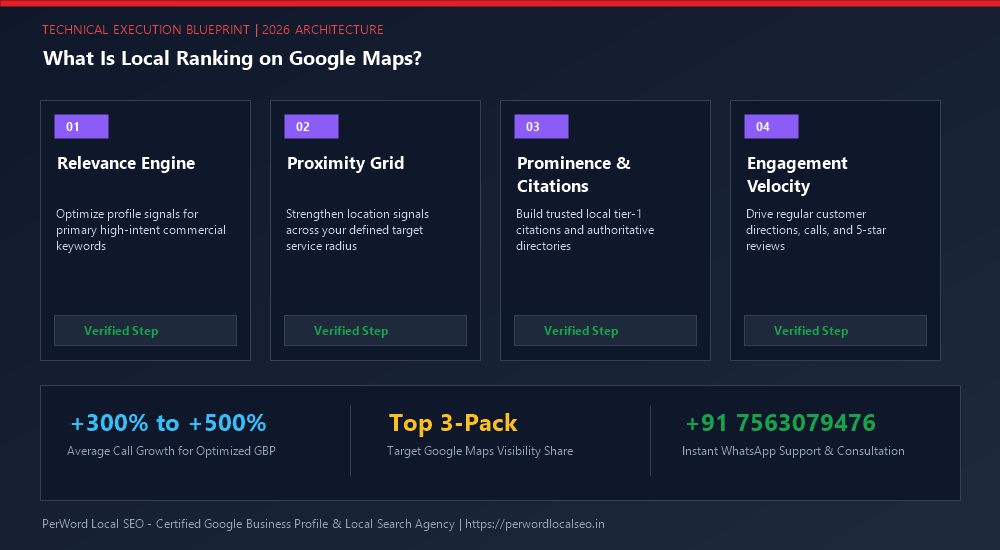
When a local query is executed, Google's ranking engine processes the request through four algorithmic calculation steps:
Entity Filtering
Identifies all verified listings whose primary/secondary categories match query keywords.
Distance Scoring
Calculates physical distance between the searcher's GPS point and each merchant's pin.
Prominence Scoring
Evaluates review velocity, star rating, backlinks, citations, and website authority.
Composite Rank
Computes the final composite score to render the 3-Pack and Maps search order.
6. Measuring Local Rank: Geo-Grid Heatmaps & Tools
To accurately assess your market position, discard manual desktop searches and utilize professional geo-spatial rank tracking software:
- Local Falcon: The pioneer of localized geo-grid tracking, measuring ranking pins across customized radiuses.
- BrightLocal: Comprehensive local SEO audit platform offering localized rank checks, citation monitoring, and review management.
- PlePer: Specialized Google Business Profile Chrome extension providing instant category analysis and CID link generation.
Want to See Your Real Geo-Grid Ranking Heat Map?
PerWord Local SEO generates 13x13 high-resolution Geo-Grid heat maps showing your exact ranking positions across every square mile of your city.
7. Case Study: Veterinary Hospital Expands Green Geo-Grid from 1 to 7 Miles
Client Profile: A 24-hour emergency animal hospital in Charlotte, North Carolina, ranked #1 within a tight 1-mile radius of their facility. However, in surrounding affluent suburbs 3 to 7 miles away, their geo-grid was completely red (ranking #12 to #25).
The Strategy:
- Shifted primary category to "Emergency veterinarian" to capture high-urgency search intent.
- Instituted a post-discharge automated SMS review system, securing 85 genuine reviews highlighting pet recovery stories across specific Charlotte neighborhoods.
- Created dedicated suburban emergency landing pages with integrated pet care emergency guides and Schema.org markup.
- Secured 25 local pet charity and rescue organization sponsorship backlinks.
The Results: Over 120 days, the hospital's Average Map Rank (AMR) improved from 14.2 to 2.1 across a 7-mile radius. Inbound emergency pet admissions increased by +310%, driving over $450,000 in additional annual clinical revenue.
8. The Strategic Playbook to Elevate Your Local Rank
- Audit Primary & Secondary Categories: Benchmark against the top 3 ranking listings in your market and align your category stack.
- Establish Systematic Review Velocity: Gather 3 to 5 genuine customer reviews every week containing target service keywords.
- Synchronize External Citations: Eliminate conflicting phone numbers and addresses across all major directories.
- Optimize Linked Landing Page: Ensure fast mobile load speeds, localize headers, and implement structured LocalBusiness schema.