Table of Contents
Executive Summary: The Science of Maps Ranking Factors
- Google Maps ranking is calculated through a dynamic composite scoring model that evaluates hundreds of independent data inputs grouped into three official pillars: Relevance, Distance, and Prominence.
- The single most influential on-profile factor is your Primary Business Category, followed closely by customer review velocity and review sentiment keywords.
- Off-page signals—including your website's organic domain authority, localized JSON-LD schema, and character-exact NAP consistency across Tier-1 directories—account for over 35% of your total Maps ranking power.
- Behavioral signals, such as user click-through rate, driving direction request completion, and direct phone call volume, act as ongoing algorithmic reinforcement to lock in your top ranking.
1. The Three Foundational Pillars: Relevance, Distance & Prominence
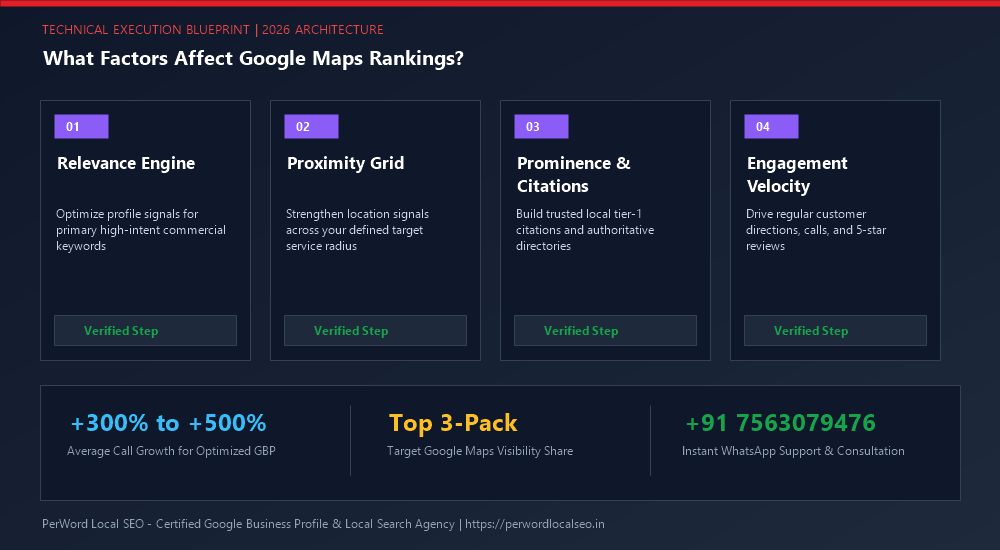
Google's local search algorithm does not treat all signals equally. To design an efficient optimization campaign, you must understand how Google categorizes and weighs ranking inputs across its three official pillars:
1. Relevance
How precisely your business entity matches what the consumer is searching for. Dictated by categories, services, products, and website content.
2. Distance
The physical distance between the searcher's device GPS coordinates and your verified business address or service territory boundary.
3. Prominence
How well-known, reputable, and authoritative your business is across the web. Dictated by reviews, citations, backlinks, and brand mentions.
2. Google Business Profile Internal Signals (36% Weight)
The attributes and configurations directly within your Google Business Profile represent the heaviest single category of ranking signals:
- Primary Category (Top Priority): The single most impactful algorithmic switch. A profile with the correct primary category will effortlessly outrank superior websites with misaligned categories.
- Secondary Categories: Up to 9 supporting categories that widen your ranking net to include related commercial services.
- Business Title: Real-world brand name. Matches with search terms provide strong signals, but artificial keyword stuffing risks profile suspension.
- Completeness of Profile Attributes: Populating opening hours, special holiday hours, booking links, payment methods, accessibility features, and health attributes.
3. Review Volume, Velocity & NLP Sentiment Signals (20% Weight)
Customer reviews provide real-time crowdsourced validation of your commercial quality:
| Review Factor | Algorithmic Mechanism | Impact Level |
|---|---|---|
| Review Velocity | Consistent weekly arrival rate of genuine reviews signals an active, healthy business. | Critical |
| Star Rating Threshold | Profiles maintaining >4.5 stars receive preferential placement; <4.0 stars suffers severe demotion. | Critical |
| Keyword Sentiment | NLP models scan review text for positive mentions of core services (e.g., "emergency AC repair"). | High |
| Owner Response Frequency | Responding to 100% of reviews signals active data management and high customer satisfaction. | Medium |
4. On-Page Organic Website & Schema Signals (16% Weight)
Google's local algorithm cross-checks your profile against the website URL linked to your listing:
- Geographic Keywords in Meta Tags: Inclusion of primary service and target city in the linked landing page's
<title>and<h1>tags. - JSON-LD LocalBusiness Schema: Structured code that connects your website directly to your Google Maps Place ID and GeoCoordinates.
- Mobile Usability & Core Web Vitals: High mobile page speed (<2.5s LCP) reduces user bounce rates, preserving behavioral authority.
- Domain Authority & Inbound Backlinks: High organic authority of your primary website directly elevates your Google Maps prominence score.
5. Proximity & Behavioral Engagement Factors (28% Weight)
How consumers interact with your map pin in the real world reinforces or degrades your position:
Directions & Navigation Tracking
When users tap "Directions" and complete their route to your physical coordinates, Google's Android telemetry confirms authentic real-world foot traffic.
Click-to-Call Frequency
A high ratio of calls placed relative to impressions signals strong relevance and satisfaction, boosting your placement for related search queries.
6. Toxic Signals: Negative Ranking Factors to Eliminate
Certain errors actively suppress your listing or trigger algorithmic demotion:
- Inconsistent NAP Across Citations: Differing phone numbers or addresses across directories lowers Google's entity trust score.
- Keyword Stuffing in Business Name: Artificially appending city names or services risks hard suspension or manual penalty.
- Shared Address with Same-Category Competitor: Triggers Google's Possum filter, suppressing your pin in favor of your neighbor.
- High Concentration of Fake Reviews: Triggers Google's automated review filter, resulting in review removal and profile shadow-banning.
7. Algorithmic Ranking Factor ROI Matrix
| Optimization Task | Implementation Effort | Ranking Impact | Recommended Action |
|---|---|---|---|
| Primary Category Alignment | Low (10 Minutes) | Massive | Audit competitor categories and select the exact high-value match. |
| Automated Review Generation | Medium (Ongoing) | Massive | Deploy SMS/Email post-service review collection workflows. |
| Local Schema & On-Page SEO | Medium (1-2 Days) | High | Add JSON-LD markup and localize landing page headers. |
| Tier-1 Citation Synchronization | Medium (1-2 Weeks) | Medium | Clean legacy directories and lock down 100% NAP consistency. |
Want to Optimize Every Single Ranking Factor?
PerWord Local SEO conducts exhaustive 50-point algorithmic audits to identify and fix suppressed signals, elevating your business into the top 3 on Google Maps.
8. Case Study: Isolating Factors to Reverse a 12-Month Rank Decline
Client Profile: A multi-chair dental practice in Phoenix, Arizona, had steadily declined from #2 to #18 on Google Maps over a 12-month period, suffering a 60% loss in new patient telephone inquiries.
The Factor Analysis: PerWord Local SEO isolated the root causes:
- An agency had changed their primary category from "Cosmetic dentist" to generic "Dental clinic".
- Their review generation had stalled—gaining only 3 reviews in 12 months while competitors gained 70+.
- A website redesign removed localized LocalBusiness schema and changed the page title tag to just "Home".
The Fix & Results: Restored "Cosmetic dentist" as primary category, deployed our automated patient review pipeline (adding 44 fresh reviews in 60 days), and restored structured JSON-LD schema. Within 75 days, the practice surged back to #1 in the Google Maps 3-Pack across Phoenix, restoring monthly patient inquiries to record highs.