Table of Contents
Executive Summary: What Is the Google Local Pack?
- The Google Local Pack (commonly referred to as the Google 3-Pack or Map Pack) is the prominent SERP block showcasing three local business listings accompanied by an interactive Google Map snippet whenever a search query demonstrates explicit or implicit local commercial intent.
- First compressed from a 7-pack to a 3-pack in August 2015 to adapt to mobile-first screen real estate, the Local Pack captures over 44% to 68% of all total clicks on local commercial search engine results pages.
- Standard components include Business Name, Review Rating Score, Review Count, Category Badge, Physical Address or Neighborhood, Operating Hours status, Primary Action CTAs (Call, Website, Directions), and Dynamic Justification Snippets.
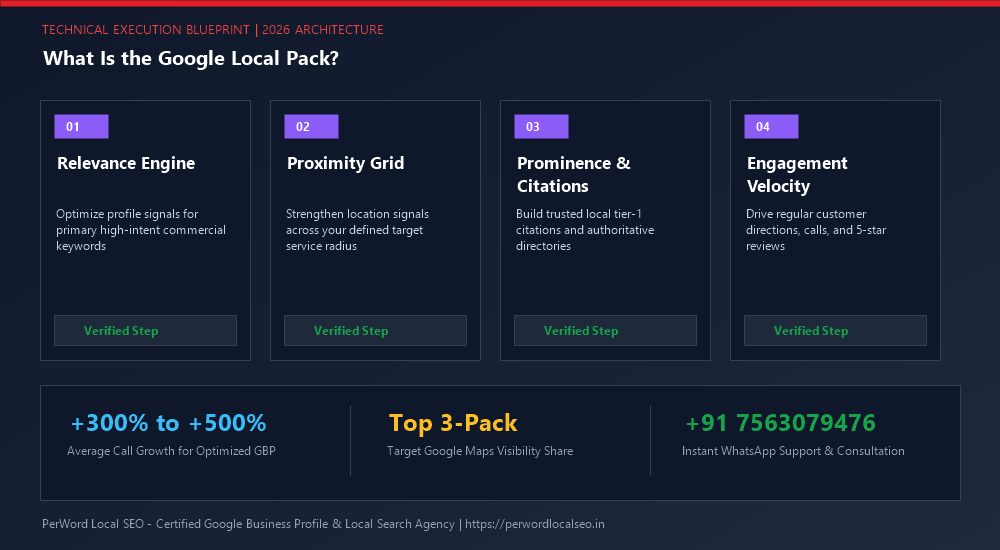
- Ranking inside the top 3 positions is determined by Google's proprietary algorithm weighing Relevance, Distance (Proximity), and Prominence. Profiles that fail to enter the 3-Pack are relegated to the secondary "More businesses" list, where user discovery drops by over 80%.
1. Defining the Google Local Pack & 3-Pack Mechanics
Whenever a consumer enters a search with local intent—such as "pediatrician near me", "emergency plumber Dallas", or simply "coffee shop" while walking through a commercial downtown district—Google modifies its standard organic search layout. Instead of displaying a plain list of ten blue links, Google generates a localized hybrid module known as the Google Local Pack.
The Local Pack sits at the very apex of the search results page, often positioned directly beneath Google Ads (or occasionally integrated with a sponsored Local Ad pin) and immediately above the traditional organic web results. For mobile users, the Local Pack commands 100% of the above-the-fold screen viewport, forcing traditional organic websites far down the scroll page.
Unlike organic web indexing, which relies predominantly on HTML page content, backlinks, and website domain authority, the Local Pack is powered by the Google Maps API database and the entity records stored within Google Business Profile. When a user queries a product or service, Google's local search algorithm queries its geographic index to match the searcher's physical location against nearby verified merchant entities.
High-Intent Traffic
Local pack searchers are not casually researching; they have immediate buying intent and convert at triple the rate of generic organic visitors.
Mobile Screen Dominance
On smartphones, the 3-pack fills the entire screen. Users can tap to dial, get turn-by-turn driving directions, or check hours in a single gesture.
Instant Trust Signals
Displaying star ratings, total review count, and physical distance directly in the snippet instantly establishes commercial credibility.
2. The Evolution: From the 7-Pack to the Mobile 3-Pack
To master the Local Pack, one must understand how it evolved. In the early era of local search (2008–2014), Google displayed the "Local 7-Pack" or "10-Pack," giving seven to ten local businesses room on the first page of desktop search results. This generous landscape allowed even moderately optimized businesses to garner steady clicks.
In August 2015, Google executed a seismic update known across the industry as the 3-Pack Compression. Google slashed the displayed local listings from seven down to three. The primary driver was mobile usability: a 7-pack required excessive downward scrolling on small 4.7-inch and 5.5-inch phone screens. By restricting the pack to three carefully curated listings, Google created an ultra-streamlined mobile experience while simultaneously creating scarcity that intensified commercial competition.
In late 2021 and 2022, Google rolled out the Vicinity Update, introducing dynamic, smaller proximity radiuses and penalizing artificial geographic keyword-stuffing in business names. In 2024 and 2025, Google integrated AI Overviews (SGE) and algorithmic "justification" badges, further transforming the 3-pack into a contextual intelligence hub that answers queries before the user even clicks through to a website.
3. Anatomical Elements: Map Pin, Snippets, Badges & CTAs
Every Google Local Pack is composed of distinct technical components. Understanding these components enables local business owners to engineer every data point for maximum click-through rates (CTR):
| Local Pack Element | Data Source & Extraction | Optimization & Ranking Impact |
|---|---|---|
| Map Viewport & Pins | Google Maps engine with numbered red teardrop pins (A, B, C) or category icons. | Visual anchor showing exact physical proximity to the user's GPS coordinates. Visual density draws the eye immediately. |
| Business Title (Entity Name) | GBP registered name attribute. | Direct keyword match signal. Must adhere strictly to Google naming guidelines to prevent suspension. |
| Star Rating & Review Quantity | Aggregated consumer reviews left on Google Maps. | Critical social proof. Profiles with >4.5 stars and 100+ reviews achieve up to 300% higher CTR than profiles with 3.9 stars. |
| Primary Category Tag | Selected primary category in Google Business Profile backend. | The single heaviest algorithmic weighting factor for relevance. Misconfigured categories completely disqualify profiles. |
| Operational Hours Status | Real-time business hours logic ("Open · Closes 8 PM" or "Closed"). | Since late 2023, Google applies an algorithmic filter favoring businesses currently open at the moment of the search. |
| Action CTAs (Direct Links) | Standard buttons: "Website", "Directions", and "Call" (mobile-only). | Facilitates zero-click conversions. Allows mobile searchers to place phone calls or launch turn-by-turn navigation in one tap. |
| Justification Snippet | Extracted from website text, customer reviews, GBP posts, or menu items. | Shows a small quotation snippet matching long-tail search terms (e.g., "Their root canal treatment was painless"). |
4. Zero-Click Search Behavior & Direct Conversion Funnels
A staggering 57% to 65% of local searches end without a traditional website click—a phenomenon known as the zero-click search. Consumers do not necessarily visit your homepage to make an appointment or buy lunch; they look at your 3-pack listing, verify your star rating, inspect your photos, and tap the "Call" or "Directions" button directly within the SERP interface.
This shift makes your Google Business Profile your true digital storefront. If your profile is incomplete, displays outdated operational hours, has missing photos, or suffers from negative unaddressed reviews, you lose the prospect before they ever reach your web assets.
The Cost of Position #4
In local search, there is virtually no reward for finishing fourth. While positions 1, 2, and 3 absorb over 85% of commercial local actions, position 4 requires the user to tap "More places" or "View all". Studies by BrightLocal show that less than 15% of searchers ever click through to the secondary list.
5. Local Pack vs. Traditional Organic SERP Comparison
Many business owners conflate organic SEO with Local Pack optimization. While they reinforce each other, the ranking mechanisms, data feeds, and click behaviors differ substantially:
| Strategic Dimension | Google Local Pack (3-Pack) | Traditional Organic SERP |
|---|---|---|
| Primary Asset Optimized | Google Business Profile entity & Maps coordinates | Website landing page, blog post, or domain URL |
| Primary Ranking Weights | Relevance (Categories), Proximity (GPS), Prominence (Reviews, Citations) | Page content, backlinks, technical crawlability, Core Web Vitals |
| Impact of Physical Distance | Extremely high. Proximity to searcher defines the ranking grid. | Low to moderate. National domains can rank anywhere regardless of physical coordinates. |
| Conversion Type | Immediate phone calls, driving directions, fast direct bookings | Page views, email sign-ups, whitepaper downloads, long sales funnels |
| Visual Prominence | Dominates above-the-fold with map graphics and review stars | Standard text snippets beneath the fold on mobile devices |
6. Algorithmic Justifications: Menu, Website, & Review Mentions
Google utilizes Justifications to validate why a particular business appears in the 3-Pack for a specialized query. These appear as small highlighted lines of text with a bold checkmark or quotation icon underneath the listing.
The four primary types of Local Pack justifications include:
- Website Mention Justification: Google's web crawler identifies the search keyword on your linked website homepage or location page (e.g., "Their website mentions emergency tooth extraction").
- Review Justification: An authentic customer review contains the exact keyword searched (e.g., "Reviewers mention gluten free pasta options").
- In-Stock / Product Justification: Extracted from Google Merchant Center or the GBP Products catalog (e.g., "In stock at nearby store: Ceramic brake pads").
- Services Justification: Extracted from your profile's configured primary and predefined secondary service list (e.g., "Provides: Commercial HVAC repair").
Want Your Business in the Google 3-Pack?
PerWord Local SEO engineers comprehensive Geo-Grid optimization, high-authority citations, review acquisition campaigns, and technical schema to push your business into positions 1–3 across your target service territory.
7. Case Study: Boutique Clinic Breaks Into 3-Pack for +420% Bookings
Client Profile: A dental and cosmetic clinic based in Manchester, UK, struggled with low visibility. Despite a beautiful website, the clinic ranked #11 to #14 on local search queries, buried deep in the "More businesses" overflow list.
The Strategy:
- Category Alignment: Swapped their generic primary category from "Medical Clinic" to "Cosmetic Dentist" to match high-value search intent.
- Review Keyword Velocity: Implemented PerWord Local SEO's automated SMS review system, prompting happy patients to mention specific treatments (e.g., "Invisalign", "Veneers") in their feedback.
- Website Geo-Landing Page Overhaul: Linked the profile to a dedicated Manchester location page with embedded LocalBusiness schema and corresponding treatment services.
- Local Citation Consistency: Cleaned up 34 legacy directory citations that had varying address formats and outdated telephone numbers.
The Results: Within 75 days, the clinic rose from position #12 into position #2 across a 6-mile radius. Inbound phone calls surged from 14/month to 78/month, driving a +420% increase in high-ticket patient consultations.
8. Schema Architecture for Local Pack Authority
Connecting your website to your Google Business Profile via JSON-LD structured data establishes an unbreakable semantic entity graph in Google's Knowledge Graph:
{
  "@context": "https://schema.org",
  "@type": "Dentist",
  "name": "Apex Cosmetic Dental Studio",
  "image": "https://example.com/assets/images/clinic-facade.jpg",
  "@id": "https://example.com/#dentist",
  "url": "https://example.com",
  "telephone": "+44-161-555-0199",
  "priceRange": "$$$",
  "address": {
    "@type": "PostalAddress",
    "streetAddress": "42 Deansgate",
    "addressLocality": "Manchester",
    "postalCode": "M3 2FE",
    "addressCountry": "GB"
  },
  "geo": {
    "@type": "GeoCoordinates",
    "latitude": 53.4808,
    "longitude": -2.2426
  },
  "openingHoursSpecification": [
    {
      "@type": "OpeningHoursSpecification",
      "dayOfWeek": ["Monday", "Tuesday", "Wednesday", "Thursday", "Friday"],
      "opens": "08:30",
      "closes": "18:00"
    }
  ],
  "sameAs": [
    "https://www.facebook.com/ApexDentalManchester",
    "https://maps.google.com/?cid=9876543210123456789"
  ]
}