Table of Contents
Executive Summary: The Mathematics of Local Pack Ranking
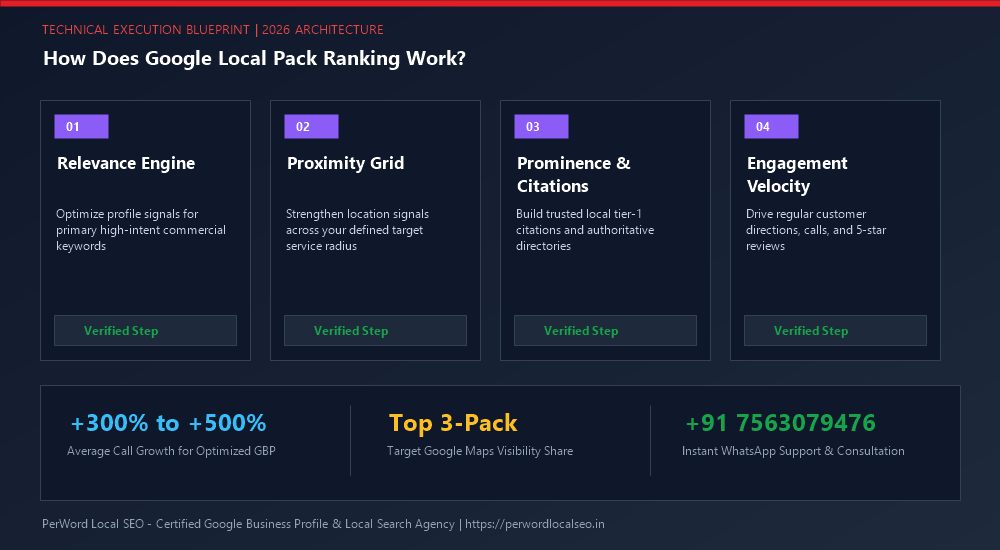
- Google ranks local businesses in the 3-Pack using an intricate multi-variable algorithm structured around three primary pillars: Relevance (how well the profile matches what the user is searching for), Distance (how far the business is from the searcher or specified location term), and Prominence (how well-known and reputable the business is across the digital ecosystem).
- The algorithm does not evaluate these three factors in isolation; it computes a compound weighted score. A highly prominent business located 3 miles away can easily outrank an un-optimized business located right across the street.
- Key scoring inputs include: Primary GBP Category selection, Secondary categories, authentic customer review velocity and review sentiment, organic website domain authority, consistent Name-Address-Phone (NAP) citations, and user interaction metrics (calls placed, directions requested).
1. The Algorithmic Triad: Relevance, Distance & Prominence
Google's official developer documentation summarizes local ranking into three straightforward concepts: Relevance, Distance, and Prominence. However, beneath this simple terminology lies one of the most sophisticated neural ranking engines in modern computer science.
When a search query is initiated, Google's algorithms query millions of local entities, calculate physical distances relative to GPS pings, parse entity relationships across knowledge graphs, and compute a ranking index within 200 milliseconds. Understanding the inner workings of each pillar is essential to engineer sustained top rankings.
2. Deep Dive: Relevance & Semantic Entity Matching
Relevance measures how accurately a local business listing matches the explicit or semantic intent behind a user's search query.
To compute relevance, Google evaluates the following core signals:
- Primary Category: Accounts for approximately 35% of a profile's initial topical match score. If you are an Italian restaurant and choose generic "Restaurant", you lose relevance points on specific queries like "authentic Neapolitan pizza".
- Predefined & Custom Services: The services populated in your GBP catalog provide explicit confirmation of commercial capability.
- Business Description & Updates: Natural language processing (NLP) models scan your business description, weekly update posts, and Q&A section for relevant semantic terms.
- Linked Website On-Page Content: Google crawls the landing page connected to your GBP "Website" button. If that page has strong H1 tags, body content, and LocalBusiness schema matching the query, your profile's relevance score increases significantly.
3. Deep Dive: Distance, Centroid Bias & The Vicinity Update
Distance (Proximity) calculates the physical geographic space between the location term used in a search (e.g., "Austin, TX") or the searcher's physical GPS device coordinates and the verified physical address of the business.
Key dynamics of the Distance factor include:
- Centroid Bias: In older algorithms, Google heavily favored businesses situated near the geographic center (the "centroid") of a municipality. Today, mobile GPS precision has localized searches down to neighborhood micro-radiuses.
- The Vicinity Update Impact: Rolled out in late 2021, the Vicinity update tightened the proximity radius for competitive terms. It significantly reduced the ranking reach of businesses that keyword-stuffed their titles, allowing hyper-local neighborhood businesses to capture top positions nearby.
- Overcoming Proximity Constraints: While you cannot physically move your building to follow every mobile user, building superior Prominence allows your business to project its ranking radius further into adjacent neighborhoods.
4. Deep Dive: Prominence, Review Velocity & Brand Footprint
Prominence measures how well-established, authoritative, and trusted your business is both offline and online. For businesses located slightly farther away from the searcher, prominence is the tiebreaker that pulls them into the 3-Pack.
Prominence signals are derived from:
- Review Quantity, Rating & Velocity: Having 250 verified 5-star reviews with consistent weekly inflow signals immense trustworthiness. A stagnant profile with 15 reviews from 2021 exhibits weak prominence.
- Review Keywords & Sentiment: Customers naturally writing phrases like "best commercial electrician in town" feeds Google's sentiment analysis algorithms.
- Local Citations & Directory Footprint: Prominence increases when authoritative platforms (Yelp, YellowPages, Better Business Bureau, industry directories, and local Chamber of Commerce listings) confirm your exact NAP details.
- Inbound Backlinks & Domain Authority: High-authority editorial backlinks from regional newspapers, community blogs, and supplier websites directly elevate your Google Maps prominence score.
5. Behavioral Signals: CTR, Dwell Time & Request Directions
Beyond static profile fields, Google monitors real-world user engagement as continuous algorithmic reinforcement:
Inbound Phone Call Rate
High call volumes triggered from your profile signal to Google that users find your listing highly relevant and satisfactory for the search term.
Direction Request Volume
Users repeatedly tapping "Directions" and actually completing the GPS route provides proof of physical foot traffic, boosting local prominence.
6. Algorithmic Factor Weight Matrix
Based on comprehensive local SEO industry research and extensive testing across thousands of local client listings by PerWord Local SEO, the estimated relative weights for Local Pack ranking factors break down as follows:
| Ranking Factor Category | Estimated Weight | Key Algorithmic Levers | Priority Level |
|---|---|---|---|
| Google Business Profile Signals | 36% | Primary Category match, Secondary Categories, Complete Profile Fields, Operational Hours | Critical |
| Review Signals | 20% | Star Rating, Total Quantity, New Review Velocity, Review Sentiment, Reviewer Geographic History | Critical |
| On-Page Website Signals | 16% | NAP consistency on footer, Localized Schema markup, City/Service keywords in title tags, PageSpeed | High |
| Proximity & Distance Signals | 14% | Physical distance to user GPS point, Centroid proximity, Service Area coverage boundaries | High |
| Inbound Link Signals | 8% | Local community backlinks, Chamber of Commerce links, Niche industry authority links | Medium |
| Citation & Directory Signals | 6% | 100% NAP consistency across Tier-1 directories (Apple Maps, Bing, Yelp, Foursquare) | Moderate |
7. Case Study: Plumbing Contractor Dominates Multi-Subdivision Pack
The Challenge: An established residential plumbing contractor based in suburbs north of Atlanta was confined to ranking in the 3-Pack only within a 0.5-mile radius of their physical shop. In four wealthy adjacent subdivisions 2 to 4 miles away, they did not even crack the top 10.
The Strategy:
- Engineered dedicated neighborhood service landing pages with detailed service maps and embedded Google Maps driving direction widgets.
- Secured 45 new authentic customer reviews over 90 days specifically mentioning the target subdivision names (e.g., "Installed our water heater in Johns Creek quickly").
- Built 50 hyper-localized tier-1 citations and acquired regional business sponsorship links.
The Results: By amplifying their Prominence and Relevance signals, the contractor expanded their top-3 Local Pack radius from 0.5 miles to over 5.5 miles, capturing the 3-pack across all four target subdivisions and increasing inbound booked service calls by +310%.
8. The 7-Step Local Pack Algorithmic Audit Protocol
Follow this checklist to audit and maximize your algorithmic scoring potential:
Verify Primary Category Dominance
Use competitor analysis tools to confirm that your primary category matches what 80%+ of top 3 ranking listings use.
Maximize Secondary Category Coverage
Select up to 5 highly relevant secondary categories to capture tangential long-tail service searches.
Establish Active Review Generation Velocity
Never let reviews stagnate. Secure 3 to 5 genuine, keyword-rich reviews every week from genuine satisfied customers.
Align On-Page Website Content with GBP Attributes
Ensure the linked webpage reflects the exact phone number, address, and localized services listed on your profile.
Clean and Synchronize All External Citations
Eliminate conflicting addresses, legacy phone numbers, or duplicated business names across directories.
Need an Algorithmic Local Pack Audit?
PerWord Local SEO uses advanced Geo-Grid tracking and algorithmic scoring models to benchmark your profile against the top 3 competitors in your exact service area.