
Table of Contents
Executive Summary: How Reviews Drive Local SEO
- Google Reviews are not just social proof—they are a direct algorithmic ranking factor accounting for approximately 17% to 22% of Google Maps 3-Pack placement power.
- Google's local algorithm evaluates reviews across five specific parameters: Quantity (Volume), Velocity (Arrival Pace), Rating Average, Diversity of Reviewers, and Keyword Sentiment Density.
- Reviews are the primary vehicle through which a business can overcome the Proximity Trap. An authoritative business with 300 reviews can rank ahead of closer competitors located just blocks from the searcher.
- Customer reviews generate a powerful CTR Flywheel: higher star ratings drive higher click-through rates, and Google's behavioral telemetry rewards those clicks with higher organic rankings.
1. The Core Connection: Reviews as Ranking Fuel
In traditional web SEO, backlinks act as votes of confidence from other websites. In Local SEO, Google Reviews are the votes of confidence from real-world human consumers.
Google’s ranking algorithm operates on machine learning models designed to surface the best real-world experiences to searchers. When hundreds of verified local consumers consistently leave detailed reviews stating that your business delivers punctual, high-quality, and transparent service, Google’s algorithms assign your Knowledge Graph entity a massive Prominence multiplier.
2. The 5 Distinct Review Algorithmic Ranking Signals
Google's local search engine evaluates review signals across five distinct computational dimensions:
| Review Ranking Factor | Algorithmic Measurement | Relative Weight |
|---|---|---|
| 1. Numerical Star Rating | Bayesian average rating across all reviews. Profiles >4.5 stars receive priority indexing. | Critical (Threshold Filter) |
| 2. Review Velocity | The steady arrival rate of new reviews over rolling 30, 60, and 90-day intervals. | Critical (Freshness Signal) |
| 3. Keyword Co-Occurrence | Frequency of relevant service keywords and city names in written review text. | High (Relevance Signal) |
| 4. Cumulative Review Volume | Total quantity of published reviews relative to top geographic competitors. | Medium (Authority Signal) |
| 5. Owner Response Rate | Percentage of reviews answered by the verified owner within 48 hours. | Moderate (Engagement Signal) |
3. NLP Semantic Parsing & Entity Keyword Associations
Google employs Bidirectional Encoder Representations from Transformers (BERT) and neural semantic algorithms to parse every submitted review. Google’s AI extracts:
- Entities: Specific commercial products and services (e.g., "dental implants", "water heater installation", "wood fence repair").
- Locations: Neighborhoods, streets, landmarks, and adjacent suburbs mentioned by clients.
- Sentiment Scores: Mathematical valence determining whether customer sentiment is overwhelmingly positive or negative.
When positive sentiment and specific service entities converge, Google awards your profile Review Justifications in the Maps 3-Pack, allowing you to rank for long-tail keywords that do not even appear in your business title!
4. Review Velocity vs. Cumulative Review Volume
A frequent question from local business owners is: "My competitor has 300 reviews and I only have 80. How can I ever outrank them?"
The answer lies in Review Velocity. Google's algorithm prioritizes recency. If your competitor gathered 300 reviews between 2019 and 2023, but has received zero new reviews in the past 6 months, their profile is algorithmically "stale". If your business collects 4 fresh, authentic reviews every single week, Google's freshness signals will propel your listing ahead of the stagnant competitor within 60 to 90 days.
5. How Review Authority Overcomes Proximity Traps
Distance is a powerful ranking barrier in Google Maps. Under normal conditions, Google displays the businesses physically closest to the searcher's phone.
However, Prominence overrides Distance. When your profile possesses overwhelming review authority—characterized by hundreds of authentic 5-star reviews, high review velocity, and rich semantic keyword density—Google's algorithm calculates that searchers are willing to travel farther to visit your superior enterprise. This expands your "green geo-grid radius" from a meager 0.5-mile circle into a massive 5 to 10-mile trade territory.
6. The CTR Flywheel: Reviews Powering Behavioral Signals
The impact of reviews extends beyond direct algorithmic weighting. Reviews power a continuous behavioral feedback loop known as the CTR Flywheel:
High Star Rating
Profile displays 4.9 stars with 200+ reviews.
Higher CTR
Searchers click your listing over rivals with 4.1 stars.
More Calls & Nav
Users place phone calls and request GPS driving directions.
Rank Elevation
Google's behavioral telemetry locks in higher ranking.
Want to Turn Customer Reviews into Local SEO Domination?
PerWord Local SEO engineers automated review acquisition engines, sentiment keyword optimization, and multi-mile radius expansion to put your business at #1.
7. Case Study: Physiotherapy Practice Expands Ranking Radius 6x
Client Profile: A sports physical therapy and rehabilitation clinic in Denver, Colorado, was confined to ranking in the top 3 on Google Maps only within 800 meters of their clinic door. Across the rest of the city, they ranked in positions #15 to #25.
The Strategy:
- Deployed PerWord Local SEO's automated SMS post-treatment review pipeline, prompting patients to describe their specific injuries (ACL rehab, rotator cuff therapy, spinal adjustment).
- Secured 94 verified reviews in 120 days, accumulating dense semantic keyword co-occurrences.
- Responded to 100% of reviews with personalized, keyword-optimized owner replies.
The Results: The clinic's top-3 Google Maps ranking radius expanded from 0.5 miles to 5.8 miles. Overall inbound patient consultations surged by +310%, adding over $280,000 in new clinical billing within six months.
8. The 90-Day Review SEO Domination Plan
| Timeframe | Operational Review Milestone | Local SEO Algorithmic Impact |
|---|---|---|
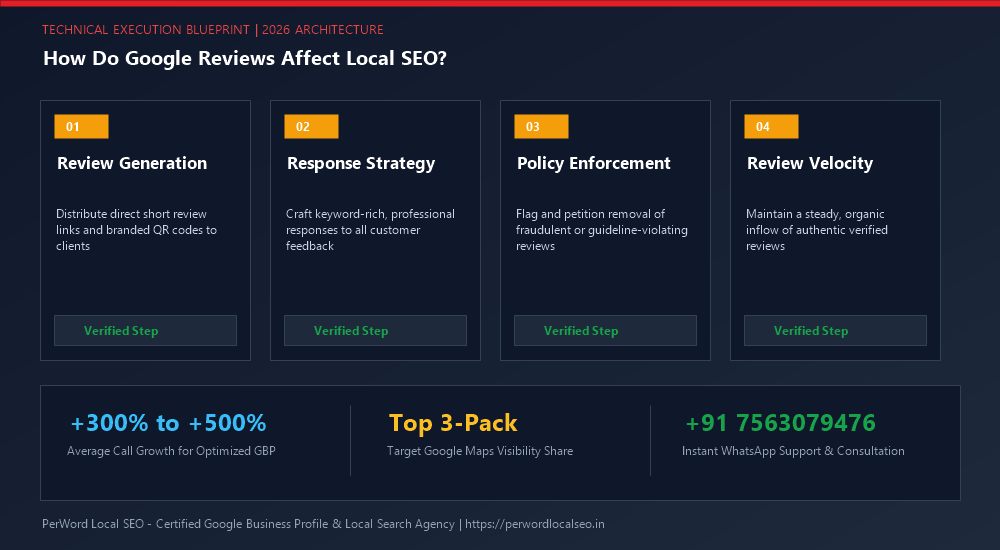
| Days 1 – 30 | Audit review baseline, deploy short direct review link, install in-store QR displays, and train frontline staff. | Initial review velocity activates Google's freshness scoring algorithm. |
| Days 31 – 60 | Integrate automated post-transaction SMS dispatch, begin keyword-rich owner responses, and flag fake competitor reviews. | Google NLP extracts service entities, triggering review justifications in the 3-Pack. |
| Days 61 – 90 | Scale to 4+ reviews weekly, benchmark Geo-Grid radius expansion, and feature review widgets on website. | Overcomes proximity boundaries, pushing profile into positions 1–3 across adjacent suburbs. |